
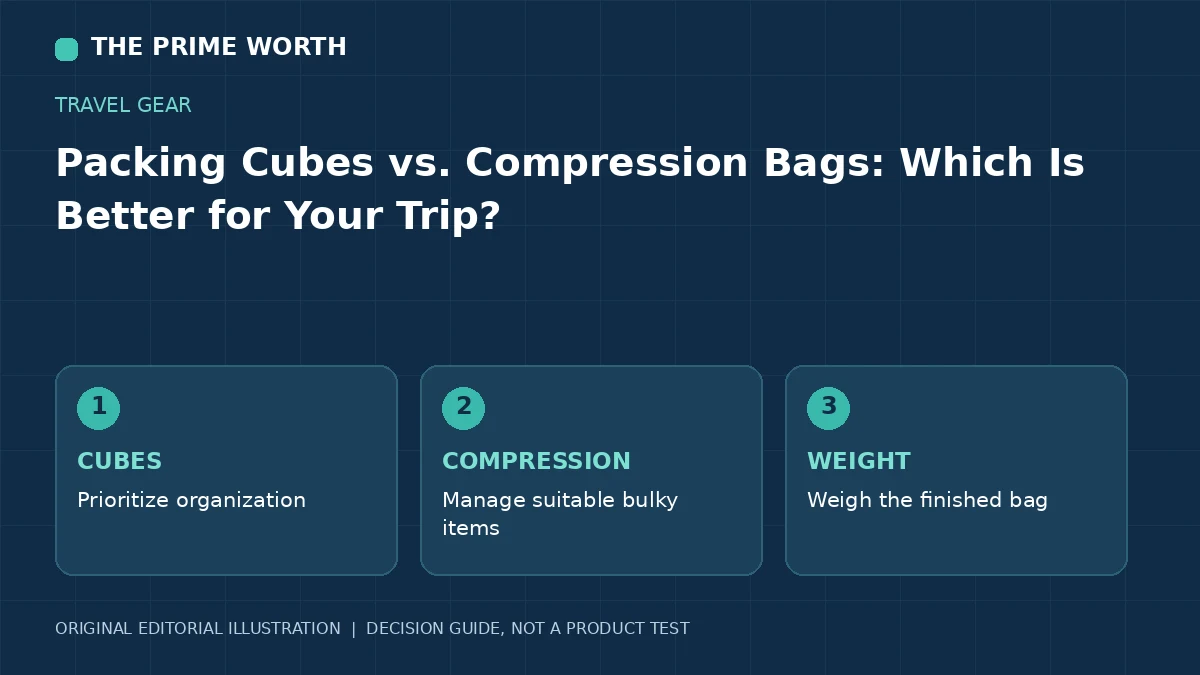
Choose packing cubes when organization and easy access are your main priorities. Consider compression bags when reducing the bulk of suitable clothing matters more. Neither approach removes weight from the contents, so weigh your finished bag instead of judging success by how much you can squeeze inside.
Decide which problem you are solving
An ordinary packing cube creates a separate compartment for clothing. A compression product aims to reduce the volume occupied by suitable contents, but designs vary: some use zippers, others roll or require a pump. Check the actual mechanism. Do not treat all products with compression in the name as equivalent or assume a specific percentage of space savings.
Think about the return journey
A packing setup should work at the destination and on the way home. Ask whether you can reopen and repack the bag without equipment, whether damp or dirty clothing has somewhere separate to go, and whether you will change hotels frequently. A system that looks tidy once may be inconvenient if it requires rebuilding the entire suitcase every morning.
Run a fair comparison at home
Use the same suitcase and exactly the same garments for both arrangements. Photograph the result, record the packed weight, and time how long it takes to retrieve one item. Leave room for a realistic return load. Do not claim that one system creates a fixed amount of extra space unless you have measured a defined comparison and explained the method.
Buy the smallest useful set
Measure the internal spaces of your luggage before ordering organizers. Start with a few sizes that fit your packing pattern rather than the largest bundle. Check zippers, seams, visibility, and cleaning instructions. Follow garment care instructions and avoid forcing fragile or structured clothing into a system that may crease or distort it.
Practical decision framework
| Factor | What to check | Limitation |
|---|---|---|
| Organization | Cubes separate categories of clothing | Compression is not necessary for every item |
| Volume | Compression can reduce the space occupied by soft clothing | Reduced volume does not reduce weight |
| Access | Compare opening and repacking effort | The best arrangement depends on how often you unpack |
| Return journey | Reserve space for worn clothing and purchases | Avoid treating maximum compression as a requirement |
| Material | Inspect seams and closures and read care instructions | Neither category guarantees waterproof protection |
Organization: what matters in practice?
Cubes separate categories of clothing. A traveler changing hotels may benefit from keeping outfits together. Compression is not necessary for every item.
For this part of the decision, write down what you already know and what remains uncertain. In particular, cubes separate categories of clothing. If you cannot confirm the relevant information, leave that entry unresolved rather than treating an assumption as a verified feature.
Volume: what matters in practice?
Compression can reduce the space occupied by soft clothing. Bulky rigid items will not shrink in the same way. Reduced volume does not reduce weight.
For this part of the decision, write down what you already know and what remains uncertain. In particular, compression can reduce the space occupied by soft clothing. If you cannot confirm the relevant information, leave that entry unresolved rather than treating an assumption as a verified feature.
Access: what matters in practice?
Compare opening and repacking effort. A cube may be easier to open for a single shirt. The best arrangement depends on how often you unpack.
For this part of the decision, write down what you already know and what remains uncertain. In particular, compare opening and repacking effort. If you cannot confirm the relevant information, leave that entry unresolved rather than treating an assumption as a verified feature.
Return journey: what matters in practice?
Reserve space for worn clothing and purchases. A system that barely fits at departure may be inconvenient later. Avoid treating maximum compression as a requirement.
For this part of the decision, write down what you already know and what remains uncertain. In particular, reserve space for worn clothing and purchases. If you cannot confirm the relevant information, leave that entry unresolved rather than treating an assumption as a verified feature.
Material: what matters in practice?
Inspect seams and closures and read care instructions. A small set can be tested with existing luggage. Neither category guarantees waterproof protection.
For this part of the decision, write down what you already know and what remains uncertain. In particular, inspect seams and closures and read care instructions. If you cannot confirm the relevant information, leave that entry unresolved rather than treating an assumption as a verified feature.
How to make the final decision
Start with the requirements that cannot be compromised, then compare the remaining options on the same basis. Keep the evidence beside each entry so you can revisit the decision if the itinerary, price or terms change. The framework above is intended to help you evaluate a specific situation, not to establish a universal ranking.
Before you decide: a quick checklist
- Identify whether access or bulk is the issue.
- Check whether a pump or special method is needed.
- Test identical contents in the same luggage.
- Weigh the complete bag after packing.
Frequently asked questions
Does compression reduce baggage weight?
No. Compressing the contents does not remove their mass; organizers also add their own weight.
Can I use both systems?
Yes, if the combination fits your bag and improves access. Test a small setup before buying multiple sets.
How this guide was prepared
This is a research-based decision guide, not a hands-on product review. Recommendations about how to compare options are editorial judgments. No products were tested, no performance scores are claimed, and hypothetical examples are labeled. Check current manufacturer, airline, seller, or provider terms before acting. The checklists and calculations are original planning frameworks, not measured product findings or a researched ranking.


1 comment