
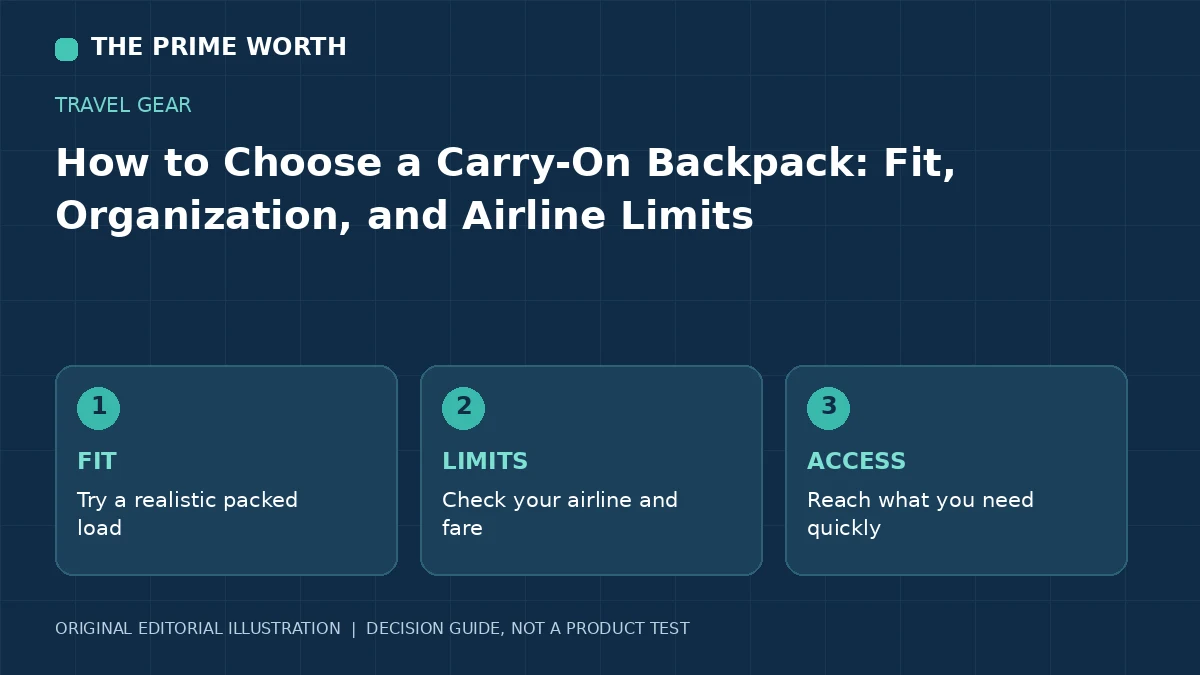
Choose a carry-on backpack by checking your airline’s allowance first, then testing comfort with a realistic load. Advertised capacity is useful for comparison, but it should not override external dimensions, packed weight, or how the bag fits your body.
Start with the ticket you will use
Look up baggage rules on the operating airline’s website, including the fare type and any personal-item allowance. Check each leg of the trip. Do not assume a retailer’s cabin-approved label applies to every carrier. Measure the bag as you will pack it, including projecting handles and pockets, using the airline’s measurement instructions.
Test fit with your own load
If possible, load the backpack with the items you normally carry and walk with it before committing. Adjust the straps and note pressure around the shoulders, neck, and lower back. Check whether the bag restricts movement or is awkward to lift. A higher purchase price or a larger capacity does not establish that the fit is right for you.
Choose organization around access
Decide which items you need during transit: documents, medication, a charger, or a laptop. Put access to these ahead of an impressive pocket count. Check laptop compartment dimensions against your actual device, including its sleeve. For clothing, compare how easily you can see and remove items without unpacking everything onto the floor.
Compare useful features and avoid excess
Consider empty weight, handle placement, zipper access, and whether replacement parts or repairs are available. Ask what water-resistance claims cover rather than treating the bag as waterproof. A separate rain cover, removable organizer, or luggage strap may be useful, but only if it suits your routine. Evaluate the packed system, not a feature list in isolation.
Practical decision framework
| Factor | What to check | Limitation |
|---|---|---|
| Dimensions | Measure the packed bag including protrusions | Check the operating airline and ticket allowance |
| Fit | Try the bag with ordinary travel contents | Comfort is personal and cannot be inferred from capacity alone |
| Organization | Place documents where they can be retrieved easily | Too many dividers may reduce usable space |
| Weather | Distinguish water-resistant fabric from waterproof construction | Do not assume a zipper is sealed |
| Ownership | Inspect stitching and zipper access and read repair terms | Compare empty weight and actual needs |
Dimensions: what matters in practice?
Measure the packed bag including protrusions. A soft bag can expand beyond its listed dimensions. Check the operating airline and ticket allowance.
For this part of the decision, write down what you already know and what remains uncertain. In particular, measure the packed bag including protrusions. If you cannot confirm the relevant information, leave that entry unresolved rather than treating an assumption as a verified feature.
Fit: what matters in practice?
Try the bag with ordinary travel contents. A short walk can reveal awkward access or strap placement. Comfort is personal and cannot be inferred from capacity alone.
For this part of the decision, write down what you already know and what remains uncertain. In particular, try the bag with ordinary travel contents. If you cannot confirm the relevant information, leave that entry unresolved rather than treating an assumption as a verified feature.
Organization: what matters in practice?
Place documents where they can be retrieved easily. A separate compartment can help with security screening. Too many dividers may reduce usable space.
For this part of the decision, write down what you already know and what remains uncertain. In particular, place documents where they can be retrieved easily. If you cannot confirm the relevant information, leave that entry unresolved rather than treating an assumption as a verified feature.
Weather: what matters in practice?
Distinguish water-resistant fabric from waterproof construction. Consider protection for documents and electronics. Do not assume a zipper is sealed.
For this part of the decision, write down what you already know and what remains uncertain. In particular, distinguish water-resistant fabric from waterproof construction. If you cannot confirm the relevant information, leave that entry unresolved rather than treating an assumption as a verified feature.
Ownership: what matters in practice?
Inspect stitching and zipper access and read repair terms. A bag used for work as well as trips may justify different features. Compare empty weight and actual needs.
For this part of the decision, write down what you already know and what remains uncertain. In particular, inspect stitching and zipper access and read repair terms. If you cannot confirm the relevant information, leave that entry unresolved rather than treating an assumption as a verified feature.
How to make the final decision
Start with the requirements that cannot be compromised, then compare the remaining options on the same basis. Keep the evidence beside each entry so you can revisit the decision if the itinerary, price or terms change. The framework above is intended to help you evaluate a specific situation, not to establish a universal ranking.
Before you decide: a quick checklist
- Check all operating airlines and fare allowances.
- Measure the packed bag and weigh it.
- Test comfort with a realistic load.
- Confirm device fit and quick-access storage.
Frequently asked questions
Is a larger liter rating better?
Only if you need the space and the packed bag meets your airline’s rules. External shape and comfort still matter.
Can one bag suit every airline?
Do not assume so. Verify current rules for the particular itinerary and ticket before travel.
How this guide was prepared
This is a research-based decision guide, not a hands-on product review. Recommendations about how to compare options are editorial judgments. No products were tested, no performance scores are claimed, and hypothetical examples are labeled. Check current manufacturer, airline, seller, or provider terms before acting. The checklists and calculations are original planning frameworks, not measured product findings or a researched ranking.


1 comment