
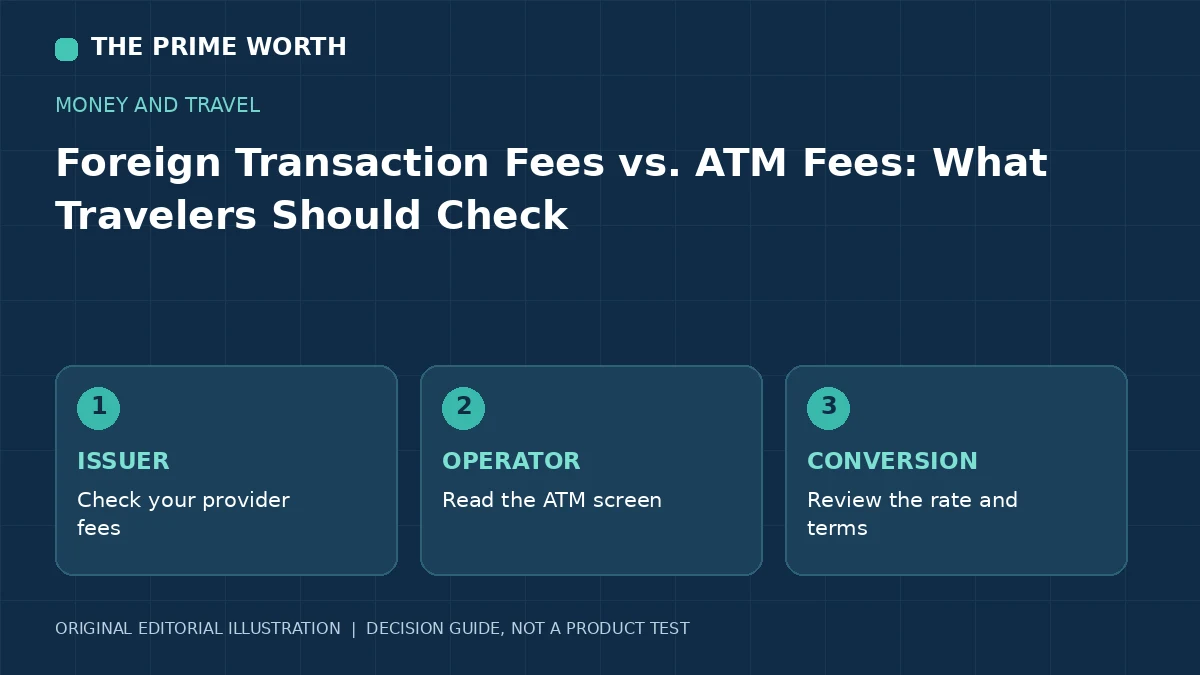
A foreign transaction fee and an ATM fee are not the same charge. One concerns qualifying international transactions under your provider’s terms; the other concerns using an ATM. A cash withdrawal may involve several costs, so read the issuer’s schedule and the ATM screen rather than relying on a single no-fee headline. CFPB: international transaction and ATM fee disclosure categories CFPB: financial terms glossary
Identify each party involved
Your account or card provider sets its own charges and conditions. An ATM operator may have separate charges, while currency conversion follows the terms of the service used. The CFPB glossary describes a foreign transaction fee as a provider charge associated with qualifying foreign-country or foreign-currency use. The precise trigger and rate must come from your own agreement, not another traveler’s experience. CFPB: financial terms glossary
Use separate lines for separate costs
Build a comparison with rows for issuer withdrawal fee, operator charge, qualifying foreign transaction charge, and exchange or conversion terms. These are questions to investigate, not a statement that every withdrawal incurs every charge. Check minimums, percentage calculations, monthly allowances, and reimbursement conditions. An allowance may have a cap or eligibility rule that matters to your trip.
Work through an illustrative withdrawal
Suppose an example provider charges a flat $3 withdrawal fee plus 2% of a hypothetical $200 withdrawal. Those two charges total $7, before any operator charge or currency-conversion effect. This is invented arithmetic, not a real product quote. Your agreement determines the actual fee base, currency, rounding, and which charges apply. Check the final statement against the original terms.
Read choices before confirming
If an ATM or terminal offers currency conversion, review the displayed rate, markup information, and alternatives before accepting. Do not assume that paying in a familiar currency eliminates your card provider’s fees. If the total is unclear, cancel before confirming and consult the provider. Cash needs, security, and access also matter; minimizing a fee is not the only objective.
Practical decision framework
| Factor | What to check | Limitation |
|---|---|---|
| Card fee | Distinguish a foreign transaction charge from the purchase amount | Check the exact card agreement |
| ATM fee | Distinguish operator charges from issuer withdrawal charges | Read the displayed terms |
| Conversion | Identify the currency in which the transaction is offered | Compare the total rather than one percentage |
| Fixed versus variable | A fixed fee behaves differently from a percentage fee | Actual terms vary |
| Records | Compare the receipt with the settled statement | Contact the provider about unexplained charges |
Card fee: what matters in practice?
Distinguish a foreign transaction charge from the purchase amount. The issuer terms determine whether it applies. Check the exact card agreement.
For this part of the decision, write down what you already know and what remains uncertain. In particular, distinguish a foreign transaction charge from the purchase amount. If you cannot confirm the relevant information, leave that entry unresolved rather than treating an assumption as a verified feature.
ATM fee: what matters in practice?
Distinguish operator charges from issuer withdrawal charges. Both can appear in a single transaction. Read the displayed terms.
For this part of the decision, write down what you already know and what remains uncertain. In particular, distinguish operator charges from issuer withdrawal charges. If you cannot confirm the relevant information, leave that entry unresolved rather than treating an assumption as a verified feature.
Conversion: what matters in practice?
Identify the currency in which the transaction is offered. Conversion offers may use different rates and fees. Compare the total rather than one percentage.
For this part of the decision, write down what you already know and what remains uncertain. In particular, identify the currency in which the transaction is offered. If you cannot confirm the relevant information, leave that entry unresolved rather than treating an assumption as a verified feature.
Fixed versus variable: what matters in practice?
A fixed fee behaves differently from a percentage fee. Hypothetical transaction sizes can illustrate the difference. Actual terms vary.
For this part of the decision, write down what you already know and what remains uncertain. In particular, a fixed fee behaves differently from a percentage fee. If you cannot confirm the relevant information, leave that entry unresolved rather than treating an assumption as a verified feature.
Records: what matters in practice?
Compare the receipt with the settled statement. A pending amount may not be final. Contact the provider about unexplained charges.
For this part of the decision, write down what you already know and what remains uncertain. In particular, compare the receipt with the settled statement. If you cannot confirm the relevant information, leave that entry unresolved rather than treating an assumption as a verified feature.
How to make the final decision
Start with the requirements that cannot be compromised, then compare the remaining options on the same basis. Keep the evidence beside each entry so you can revisit the decision if the itinerary, price or terms change. The framework above is intended to help you evaluate a specific situation, not to establish a universal ranking.
Before you decide: a quick checklist
- Read the card or account fee schedule.
- Separate issuer charges from operator charges.
- Review conversion offers before accepting.
- Keep receipts and check posted transactions.
Frequently asked questions
Can a no-foreign-fee card still have ATM charges?
Yes, fee categories need to be checked separately. The particular agreement controls what applies. CFPB: international transaction and ATM fee disclosure categories
Does this guide cover credit-card cash advances?
No. Credit-card withdrawals can have different charges and interest terms. Read the credit agreement before considering one.
How this guide was prepared
This is a research-based decision guide, not a hands-on product review. Recommendations about how to compare options are editorial judgments. No products were tested, no performance scores are claimed, and hypothetical examples are labeled. Check current manufacturer, airline, seller, or provider terms before acting.



1 comment