
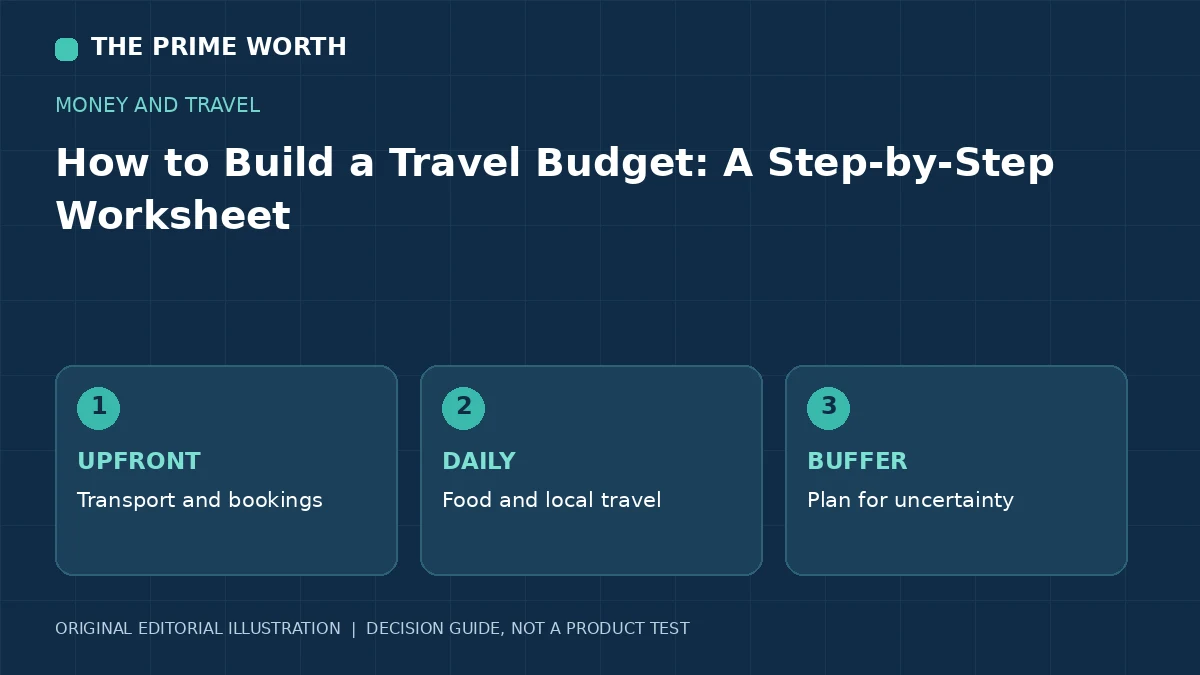
A useful travel budget includes the whole trip, not just flights and accommodation. Separate confirmed costs from estimates, include a contingency, and compare the total with money you can actually set aside. The worksheet below is a planning method, not a claim about what any destination should cost.
Set the scope and spending ceiling
Write the destination, trip length, number of travelers, and the currency used for planning. Decide whether the budget covers one person or the entire group. Set an affordable ceiling before shopping for upgrades. If several people share costs, record who pays each bill and how reimbursements will be handled rather than assuming everyone will split every expense equally.
Separate upfront and daily costs
Put transport, accommodation, required documentation, and planned activities in one group. Put food, local transport, and flexible spending in another. Add only costs that apply to your trip, and mark each line as confirmed or estimated. Keep an exchange-rate assumption beside foreign-currency estimates and remember that the actual charged amount can differ.
Use a transparent worked example
Consider a hypothetical solo trip: transport $400, accommodation $600, daily spending $300, activities $100, and a $140 contingency. The planning total is $1,540. These numbers are invented to demonstrate the method, not destination prices or an appropriate emergency reserve for everyone. Replace each line with current quotes and adjust the contingency for your circumstances.
Track commitments and update the plan
Use worksheet columns for category, estimate, booked amount, amount paid, remaining amount, currency, and notes. Avoid counting a paid deposit again as a new cost when recording the balance. During the trip, update actual spending at a regular interval. Afterward, compare estimates with reality and retain the lessons for the next budget instead of treating every overrun as unpredictable.
Practical decision framework
| Factor | What to check | Limitation |
|---|---|---|
| Scope | Define dates destinations and travelers | Label each amount clearly |
| Fixed costs | Record confirmed transport and accommodation | Avoid counting deposits twice |
| Daily costs | Estimate meals local transport and activities | Update estimates as plans change |
| Currency | Record original currency and conversion assumptions | Keep fees on separate lines |
| Contingency | Reserve room for unexpected ordinary expenses | Do not treat the reserve as money already spent |
Scope: what matters in practice?
Define dates destinations and travelers. A shared room cost differs from a per-person meal cost. Label each amount clearly.
For this part of the decision, write down what you already know and what remains uncertain. In particular, define dates destinations and travelers. If you cannot confirm the relevant information, leave that entry unresolved rather than treating an assumption as a verified feature.
Fixed costs: what matters in practice?
Record confirmed transport and accommodation. Separate paid amounts from remaining balances. Avoid counting deposits twice.
For this part of the decision, write down what you already know and what remains uncertain. In particular, record confirmed transport and accommodation. If you cannot confirm the relevant information, leave that entry unresolved rather than treating an assumption as a verified feature.
Daily costs: what matters in practice?
Estimate meals local transport and activities. Use a realistic daily pattern rather than a single optimistic average. Update estimates as plans change.
For this part of the decision, write down what you already know and what remains uncertain. In particular, estimate meals local transport and activities. If you cannot confirm the relevant information, leave that entry unresolved rather than treating an assumption as a verified feature.
Currency: what matters in practice?
Record original currency and conversion assumptions. Actual settlement amounts may differ. Keep fees on separate lines.
For this part of the decision, write down what you already know and what remains uncertain. In particular, record original currency and conversion assumptions. If you cannot confirm the relevant information, leave that entry unresolved rather than treating an assumption as a verified feature.
Contingency: what matters in practice?
Reserve room for unexpected ordinary expenses. A delayed connection can change the plan. Do not treat the reserve as money already spent.
For this part of the decision, write down what you already know and what remains uncertain. In particular, reserve room for unexpected ordinary expenses. If you cannot confirm the relevant information, leave that entry unresolved rather than treating an assumption as a verified feature.
How to make the final decision
Start with the requirements that cannot be compromised, then compare the remaining options on the same basis. Keep the evidence beside each entry so you can revisit the decision if the itinerary, price or terms change. The framework above is intended to help you evaluate a specific situation, not to establish a universal ranking.
Before you decide: a quick checklist
- Set trip scope, currency, and an affordable ceiling.
- Separate estimates, bookings, deposits, and balances.
- Include relevant fees and a contingency.
- Review actual spending and update future estimates.
Frequently asked questions
How much contingency should I add?
There is no one percentage for everyone. Consider itinerary uncertainty, existing cover, access to funds, and your wider finances.
Should I buy gear before budgeting?
List the necessary gear inside the budget first. Otherwise small purchases can become an untracked extra trip cost.
How this guide was prepared
This is a research-based decision guide, not a hands-on product review. Recommendations about how to compare options are editorial judgments. No products were tested, no performance scores are claimed, and hypothetical examples are labeled. Check current manufacturer, airline, seller, or provider terms before acting. The checklists and calculations are original planning frameworks, not measured product findings or a researched ranking.



2 comments