
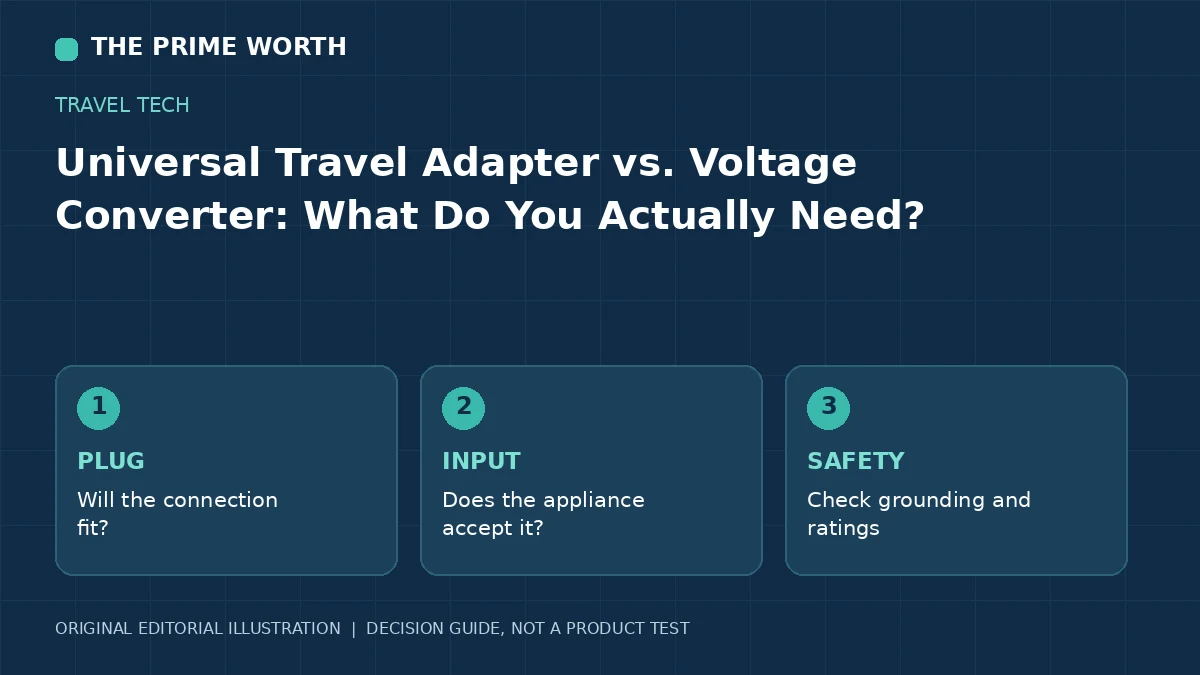
A plug adapter changes how a plug connects to a socket; it does not convert the electricity supply’s voltage or frequency. Whether you need a converter depends on the appliance’s input rating and the destination supply. Check both before buying or connecting anything. Electrical Safety First: travel adaptors
Separate physical fit from electrical compatibility
A plug that fits is not proof that an appliance is safe to use. Electrical Safety First explains that travel adapters do not convert voltage or frequency. Some adapters are also unsuitable for equipment that requires an earth connection. A product described as universal should therefore be checked against the countries, socket arrangements, and appliance requirements involved in your itinerary. Electrical Safety First: travel adaptors
Read the appliance, not just the packaging
Locate the input information on the appliance or its original power supply. Compare the stated voltage and frequency range with the destination supply using official travel or manufacturer information. Do not infer compatibility from a USB port or the device’s appearance. If the rating plate is missing, unclear, or inconsistent with the manual, contact the manufacturer before use.
Treat converters as appliance-specific purchases
Do not buy a converter solely because it claims a high wattage. Ask the appliance manufacturer whether the particular converter type is appropriate and whether its continuous rating covers the load. Heating appliances and electronically controlled equipment deserve particular care. A compatible travel version or equipment provided at the accommodation may be a simpler option than carrying an unsuitable converter.
Check the whole connection
Confirm grounding requirements, maximum ratings, and instructions for every part of the connection. Avoid stacking adapters or treating a travel adapter as a permanent installation. Inspect for damage before use and stop if a connection becomes loose or behaves abnormally. If you cannot establish compatibility, do not experiment; seek advice from the manufacturer or a qualified electrical professional.
Practical decision framework
| Factor | What to check | Limitation |
|---|---|---|
| Plug shape | Compare the destination socket and appliance plug | An adapter does not change voltage |
| Input label | Read the voltage and frequency range on each appliance | Do not infer compatibility from brand or appearance |
| Converter suitability | Consult the appliance manufacturer about converter compatibility | Do not improvise electrical connections |
| Grounding | Check whether the appliance requires a grounded connection | Avoid products with unclear safety documentation |
| Trip planning | List each device and destination separately | Verify current local supply information and manufacturer instructions |
Plug shape: what matters in practice?
Compare the destination socket and appliance plug. A physically compatible connection is only one requirement. An adapter does not change voltage.
For this part of the decision, write down what you already know and what remains uncertain. In particular, compare the destination socket and appliance plug. If you cannot confirm the relevant information, leave that entry unresolved rather than treating an assumption as a verified feature.
Input label: what matters in practice?
Read the voltage and frequency range on each appliance. A charger labeled for the destination supply may need only a suitable plug adapter. Do not infer compatibility from brand or appearance.
For this part of the decision, write down what you already know and what remains uncertain. In particular, read the voltage and frequency range on each appliance. If you cannot confirm the relevant information, leave that entry unresolved rather than treating an assumption as a verified feature.
Converter suitability: what matters in practice?
Consult the appliance manufacturer about converter compatibility. Heating appliances and motor-driven equipment may have different requirements. Do not improvise electrical connections.
For this part of the decision, write down what you already know and what remains uncertain. In particular, consult the appliance manufacturer about converter compatibility. If you cannot confirm the relevant information, leave that entry unresolved rather than treating an assumption as a verified feature.
Grounding: what matters in practice?
Check whether the appliance requires a grounded connection. A travel accessory must preserve required protection. Avoid products with unclear safety documentation.
For this part of the decision, write down what you already know and what remains uncertain. In particular, check whether the appliance requires a grounded connection. If you cannot confirm the relevant information, leave that entry unresolved rather than treating an assumption as a verified feature.
Trip planning: what matters in practice?
List each device and destination separately. Borrowing a compatible appliance may avoid a complicated purchase. Verify current local supply information and manufacturer instructions.
For this part of the decision, write down what you already know and what remains uncertain. In particular, list each device and destination separately. If you cannot confirm the relevant information, leave that entry unresolved rather than treating an assumption as a verified feature.
How to make the final decision
Start with the requirements that cannot be compromised, then compare the remaining options on the same basis. Keep the evidence beside each entry so you can revisit the decision if the itinerary, price or terms change. The framework above is intended to help you evaluate a specific situation, not to establish a universal ranking.
Before you decide: a quick checklist
- Identify destination sockets and supply.
- Read appliance input voltage and frequency.
- Confirm grounding and load requirements.
- Follow both adapter and appliance instructions.
Frequently asked questions
Does universal mean voltage-converting?
No. A universal plug adapter can support several plug arrangements without converting voltage. Verify the exact product function. Electrical Safety First: travel adaptors
Should I bring a converter for every device?
Not automatically. Decide using each appliance’s input rating and the destination supply, and ask its manufacturer if uncertain.
How this guide was prepared
This is a research-based decision guide, not a hands-on product review. Recommendations about how to compare options are editorial judgments. No products were tested, no performance scores are claimed, and hypothetical examples are labeled. Check current manufacturer, airline, seller, or provider terms before acting.


2 comments