
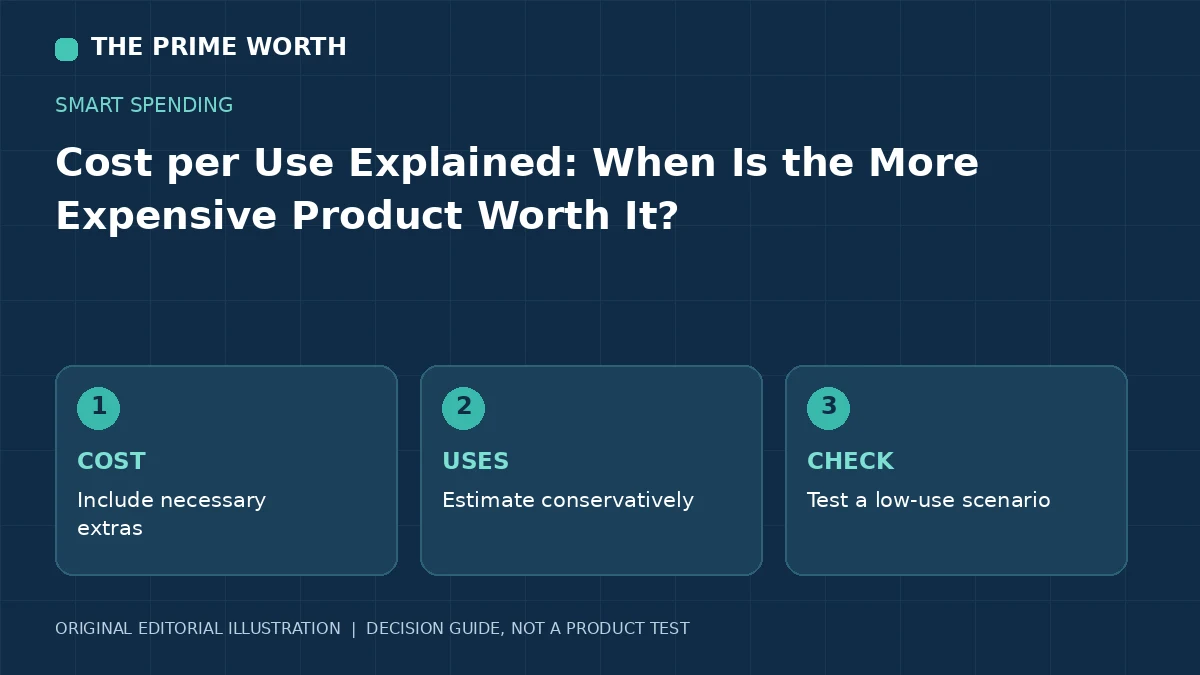
Cost per use divides a product’s ownership cost by the number of times you use it. It can help compare purchases, but it does not prove that expensive products last longer or that a purchase is affordable. The calculation is only as reliable as the assumptions you put into it.
Use a complete and consistent formula
A practical planning formula is: cost per use equals purchase price plus expected maintenance and required accessories, minus a cautious resale estimate, divided by expected uses. Keep the same definition of a use for both options. For a suitcase, that might be one trip; for headphones, one listening day. Avoid mixing measures to make a preferred product look cheaper.
Compare two hypothetical purchases
Imagine a $60 item used 30 times, with no other costs: the cost per use is $2. A $150 alternative used 100 times costs $1.50 per use. These invented examples demonstrate arithmetic, not durability evidence. If the second item is used only 40 times, its cost rises to $3.75 per use. Usage assumptions can change the apparent winner.
Stress-test the optimistic story
Run a low-use scenario, add a plausible repair cost, and try a zero-resale case. If the purchase only looks sensible under a perfect outcome, treat the result cautiously. Consider borrowing, renting, repairing, or keeping an existing item. A product you already own may meet the need without the immediate cost of replacing it, even when a new model has attractive features.
Keep affordability separate from value
A lower estimated lifetime cost does not remove the need to pay today. Set an affordable spending limit before comparing premium options, and consider what else the money is needed for. Do not count potential resale proceeds as guaranteed cash. Use cost per use as one decision aid alongside fit, safety, reliability evidence, convenience, and actual need—not as permission to overspend.
Practical decision framework
| Factor | What to check | Limitation |
|---|---|---|
| Frequency | Estimate realistic uses rather than hoped-for uses | Do not assume a high price increases usage |
| Complete cost | Include known maintenance and required accessories | Resale value is uncertain |
Frequency: what matters in practice?
Estimate realistic uses rather than hoped-for uses. A bag used twice a year differs from a daily work bag. Do not assume a high price increases usage.
For this part of the decision, write down what you already know and what remains uncertain. In particular, estimate realistic uses rather than hoped-for uses. If you cannot confirm the relevant information, leave that entry unresolved rather than treating an assumption as a verified feature.
Complete cost: what matters in practice?
Include known maintenance and required accessories. Compare products over the same period. Resale value is uncertain.
For this part of the decision, write down what you already know and what remains uncertain. In particular, include known maintenance and required accessories. If you cannot confirm the relevant information, leave that entry unresolved rather than treating an assumption as a verified feature.
How to make the final decision
Start with the requirements that cannot be compromised, then compare the remaining options on the same basis. Keep the evidence beside each entry so you can revisit the decision if the itinerary, price or terms change. The framework above is intended to help you evaluate a specific situation, not to establish a universal ranking.
Before you decide: a quick checklist
- Use the same definition of a use.
- Include necessary extras and maintenance.
- Test lower usage and zero resale.
- Check affordability before choosing.
Frequently asked questions
Is the lowest cost per use always the best option?
No. Safety, suitability, cash available, and uncertainty can outweigh a small modeled saving.
Can I count uses I hope to make?
You can model them, but label them as estimates and compare with your actual habits. Do not present hoped-for use as fact.
How this guide was prepared
This is a research-based decision guide, not a hands-on product review. Recommendations about how to compare options are editorial judgments. No products were tested, no performance scores are claimed, and hypothetical examples are labeled. Check current manufacturer, airline, seller, or provider terms before acting. The checklists and calculations are original planning frameworks, not measured product findings or a researched ranking.



1 comment